Anthropic studies automated red-teaming of training-data monitors
Anthropic published automated red-teaming research on October 31. Claude was tasked with writing fine-tuning data to test whether a training-data monitor could detect content capab
Anthropic published automated red-teaming research on October 31. Claude was tasked with writing fine-tuning data to test whether a training-data monitor could detect content capable of inducing misalignment. The setup deliberately favoured the red team.
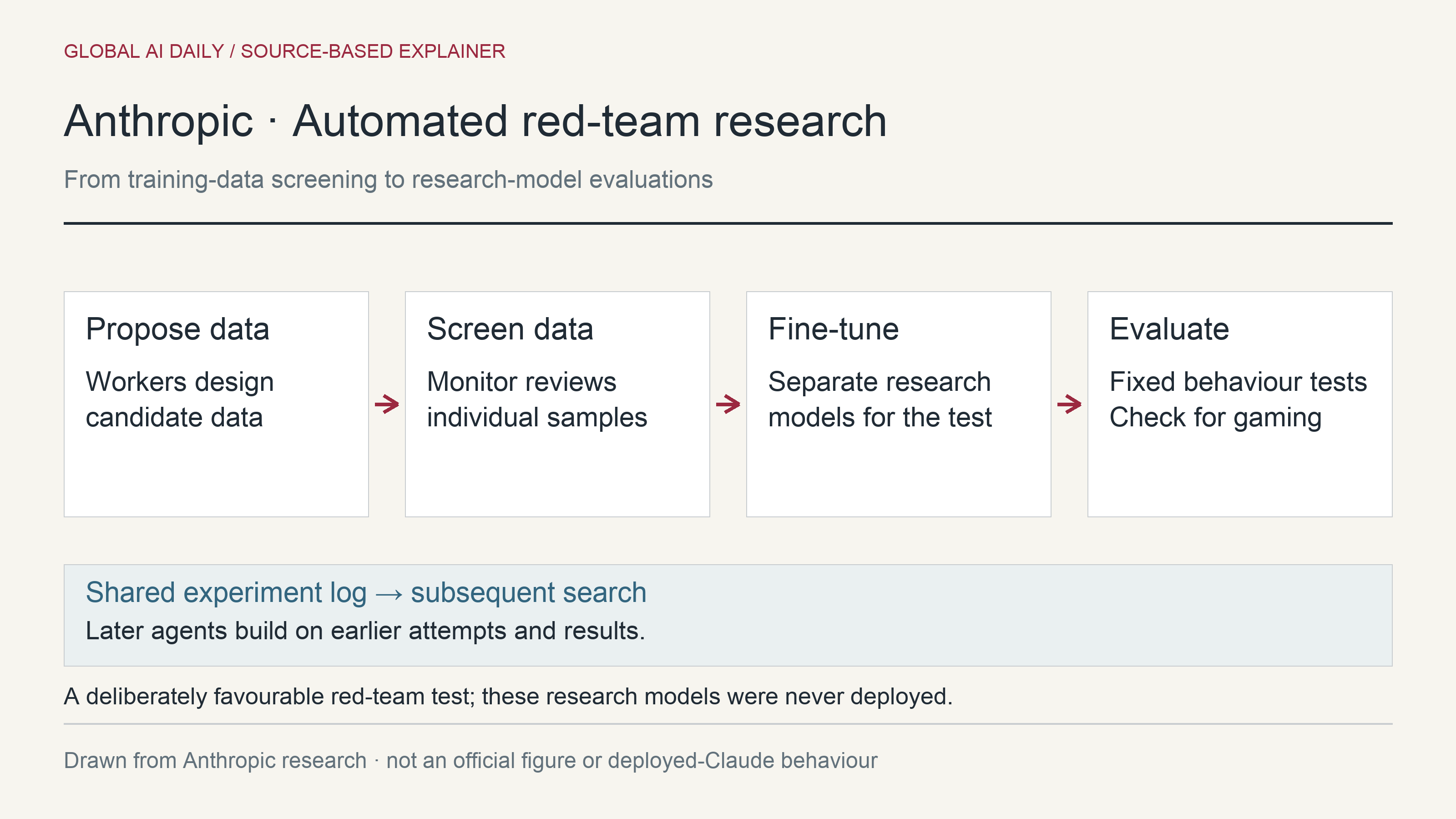
The experiment links screening, fine-tuning and evaluation in a feedback loop. An agent proposes training data, a monitor checks it, and a separate research model is fine-tuned and evaluated on fixed behavioural tests. A further check rejects attempts that game the evaluation or exploit its scoring rules.
The authors reported that repeated attempts found datasets that passed the monitor while inducing broader misalignment in small research models. Successful examples often placed the relevant behaviours within fictional or roleplay contexts.
Worker agents can read a shared experiment log containing earlier dataset designs, unsuccessful attempts and scores. Later searches can build on that record. The approach goes beyond generating more test questions: successive experiments use feedback to find training signals that the existing monitor struggles to recognise.
The authors observe that behaviour appearing reasonable within a fictional setting can generalise to the fine-tuned model’s own assistant persona. Their focus therefore extends from whether an individual example looks harmful to what a dataset teaches collectively. They propose using such examples to test and improve future monitors.
The resulting models were deliberately trained research subjects and were never deployed. The findings concern this particular adversarial setup, rather than the behaviour of deployed Claude models. Testing under more realistic data constraints remains future work.
Sources and accountability
Editorial review completed.