Hume introduces structured decisions directly from audio
Hume launched its Audio Decision API on November 2. It accepts raw audio and user-defined questions and returns probabilities over candidate answers. Stated uses include call quali
Hume launched its Audio Decision API on November 2. It accepts raw audio and user-defined questions and returns probabilities over candidate answers. Stated uses include call quality review, side-channel decisions for voice agents and searching recordings.
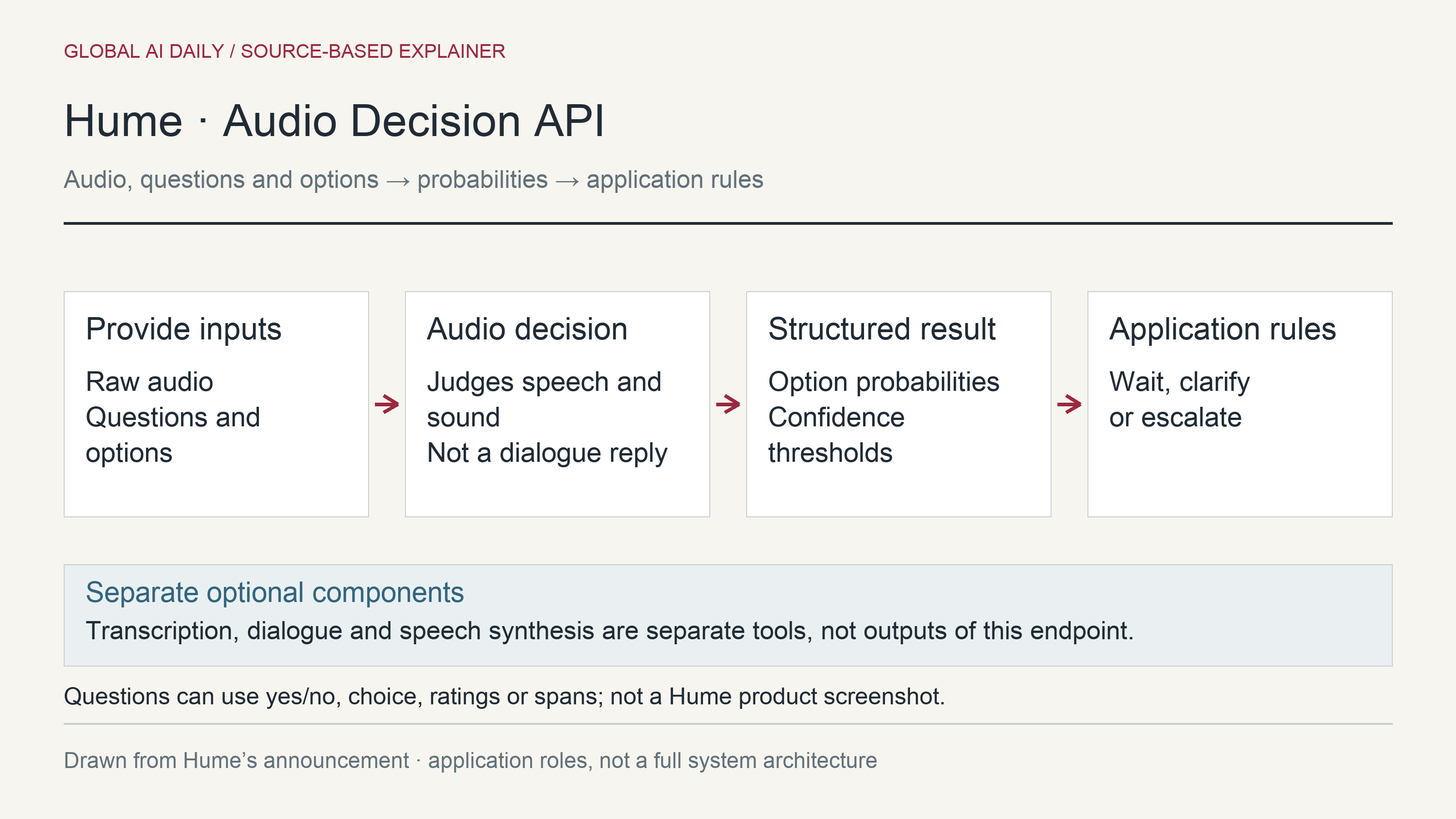
The judgments can use more than the words in a recording, including pauses, sighs, overlapping speakers and background sounds. Hume gives customer-service examples such as asking whether a caller sounds uncertain, whether several people are speaking, or whether background noise is excessive, then passing those results into a business workflow.
The interface supports yes/no, choice, ordered rating and event-span questions. Responses do not contain transcripts, conversational replies or explanations. Users can ask multiple questions about the same audio and connect confidence thresholds to business rules.
Developers define the questions, answer options and confidence thresholds, and can attach context or ask several questions about one recording. Transcription, the language model and speech synthesis are separate parts of the official example workflow. Audio judgments can act as an additional signal when deciding whether to wait, clarify or escalate.
Another use is analysing and searching recorded calls for interruptions, reassuring delivery or cases needing review, then locating relevant moments. Naturalness, patience and emotion involve human perception, on which listeners may disagree. Hume recommends validating evaluations against representative human ratings rather than treating a model’s score as an objective label.
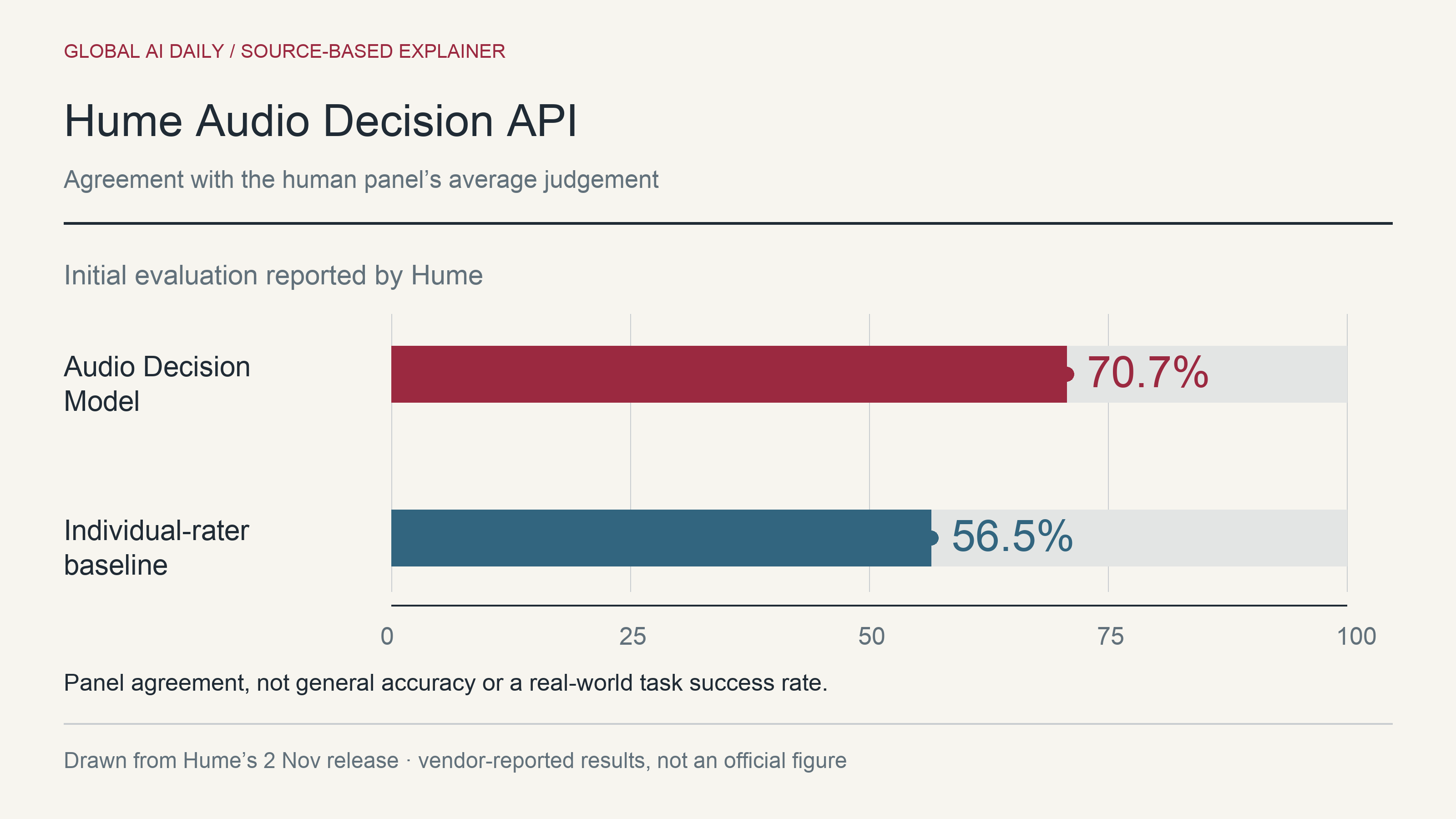
Hume reports 70.7% agreement with a human panel’s average judgement, compared with a 56.5% individual-rater baseline. These are vendor-reported results. API access requires an application, and the announcement does not include open model weights.
Sources and accountability
Editorial review completed.