ReproBridge packages experiment-reproduction knowledge for reuse
A preprint reports higher reproduction success and lower downstream API spending on selected tasks, with important selection, auditing and upstream-cost limits.
In a ReproBridge preprint submitted on November 5, Yubo Wang and four coauthors propose preserving the procedures, repairs and decisions recovered during experiment reproduction so that later agents can reuse them independently. On selected tasks and four tested models, the authors report mean reproduction success rising from 76.4% to 92.6%, a gain of 16.2 percentage points. Success follows a fixed scoring rule; these numbers are not an overall reproduction rate for machine-learning research.
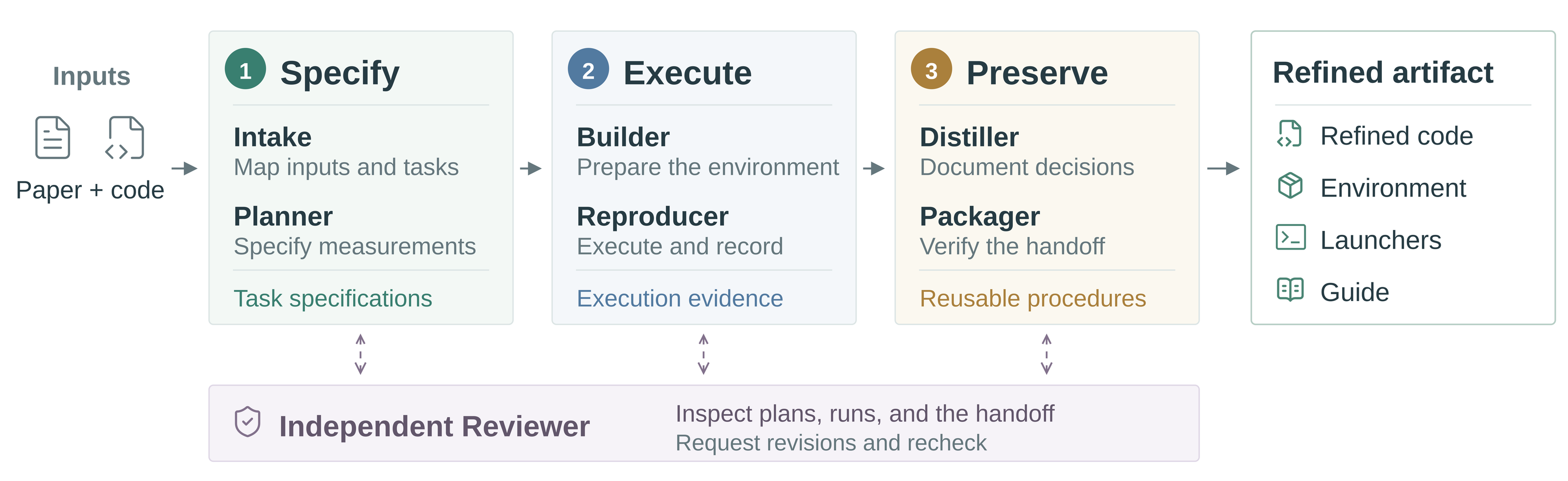
The deliverable has four parts: refined code, environment setup, experiment launchers and a reproduction guide. The workflow specifies tasks and measurement rules, prepares the environment and executes experiments, then records decisions and checks the handoff. An independent review role challenges evidence in separate contexts and requests revisions. The guide explains both the executable steps and the reasons for settings and changes, including unresolved ambiguities. Later sessions do not receive the construction conversation.
Not every curated task enters the success-rate denominator. From 36 retained papers, the team curated 1,463 tasks; 1,029 with human-verified references numerically compatible with the published results enter downstream evaluation, spanning 387 experiments. Each has five human-verified reference observations. Coding-agent assistance is allowed during reference collection, while humans inspect the actual scripts and measurements. Tasks distinguish full procedures from evaluation of permitted official checkpoints; checkpoint evaluation alone does not establish completion of training.
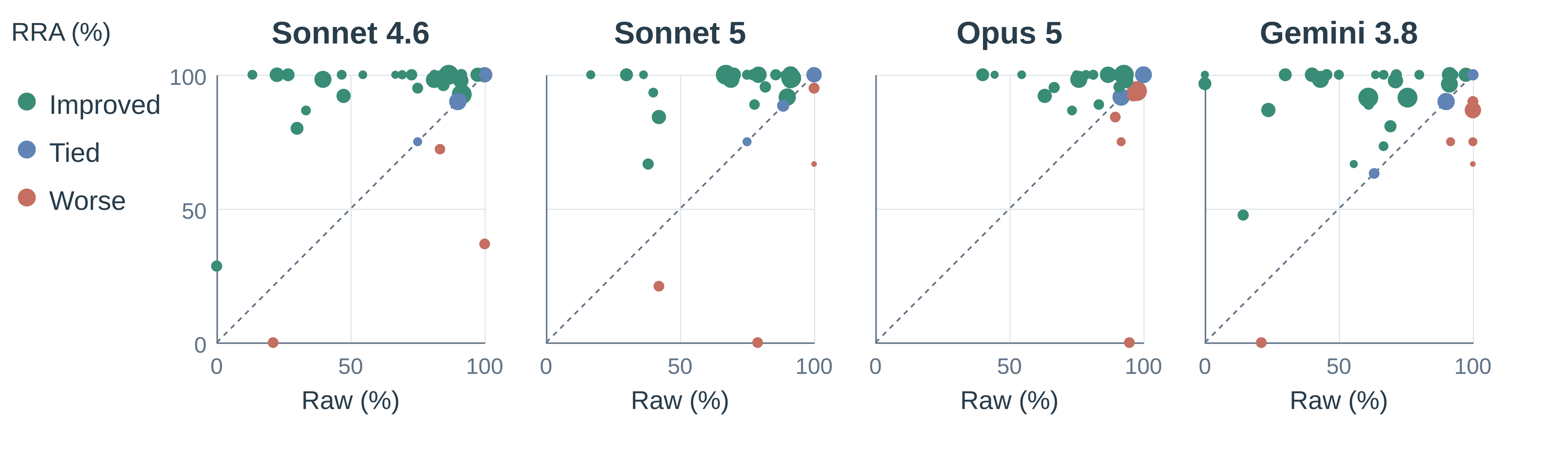
Four models receive the paper, tasks and either raw code or the refined artifact in fresh sessions. Success requires a new measurement inside a fixed compatibility interval and no execution violation confirmed by an independent Auditor; copying a matching number does not qualify. The main results aggregate three evaluations, and cross-model summaries weight models equally. The success-rate spread narrows from 21.6 to 3.9 percentage points. However, the paper-level analysis uses the first evaluation, and success still falls on three to six papers per model: refinement does not improve every case.
The reported 19.7% mean reduction in API spending concerns downstream Reproducer sessions, including failed attempts. It equally weights each model’s reduction relative to its raw-code condition. Construction, independent verification, GPU execution, maintenance and human review carry separate costs. The paper records $5,026 in construction API spending for the 36 artifacts. The percentage is therefore not a reduction in the entire research project’s cost, and it does not guarantee that a first use recovers the construction investment.
The findings support preserving execution knowledge for subsequent reproduction on the retained tasks and tested agents. Numerical compatibility does not certify scientific validity or complete fidelity to the intended experiment; refined artifacts can retain mistaken assumptions, and automated auditing still misses violations. The comparison also combines upstream investigation, repair, review and packaging, rather than isolating a change in documentation format. This publication has not independently rerun the experiments. The work remains a preprint, and its results should be read with the selection and audit limitations.
Sources and accountability
Editorial review completed.