BAAI, BUPT, and Peking University open-source LLaCO-8B continuous diffusion LLM, topping MATH at 62.12
On November 20, BAAI, Beijing University of Posts and Telecommunications, and Peking University open-sourced LLaCO-8B, a continuous diffusion language model framework with code and
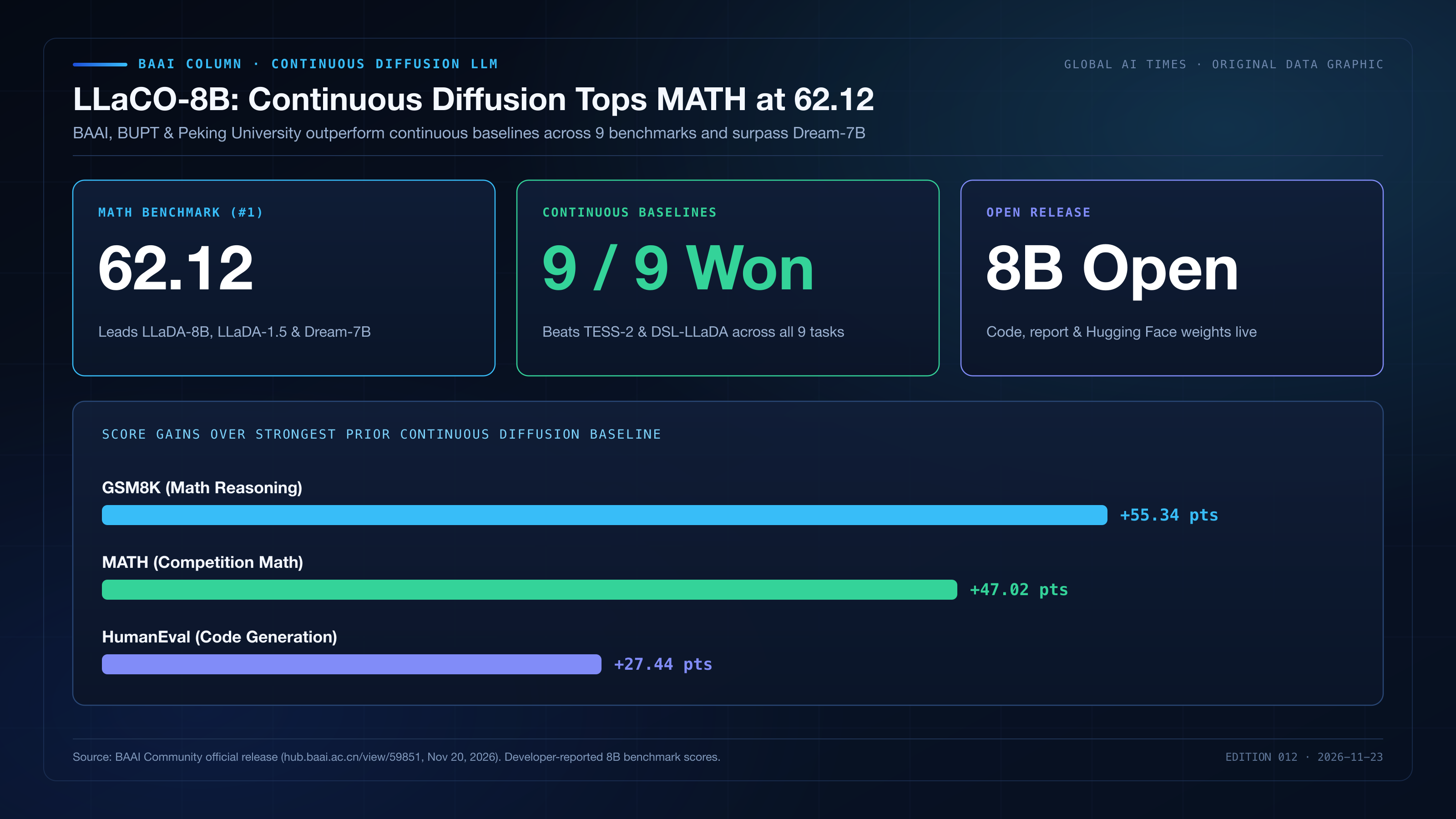
On November 20, researchers from the Beijing Academy of Artificial Intelligence (BAAI), Beijing University of Posts and Telecommunications, and Peking University released LLaCO-8B—an open-source 8B continuous diffusion language model framework with project page, GitHub code, and Hugging Face weights—tackling the longstanding quality gap between continuous and discrete text diffusion at scale.
Analyzing embedding geometry, the authors showed that tokens in 4096-dimensional representation spaces are nearly mutually orthogonal: Euclidean decoding introduces spurious flips as norms shrink, and even when noise reaches 11 times signal strength, only about 10% of source tokens lose top-1 rank. Standard schedules therefore suffer severe time compression, spending over 90% of training budget where token identity barely changes.
To correct this, the team introduced a log-scale rank retention metric—matching empirical curves within 2% without parameter fitting—and redistributed timesteps along true identity decay, spreading rank decay for tokens like "language" from the final ~9% of steps across roughly 90% of the schedule.
In author-reported 8B evaluations, LLaCO-8B outperformed continuous diffusion models TESS-2 and DSL-LLaDA across all nine benchmarks—gaining 55.34 points on GSM8K, 47.02 on MATH, and 27.44 on HumanEval over the strongest prior continuous baseline. Against discrete diffusion models LLaDA-8B, LLaDA-1.5-8B, and Dream-7B, LLaCO-8B led on MMLU, GPQA, and GSM8K while ranking first overall on MATH at 62.12.
Sources and accountability
Editorial review completed.