Beijing National AI Medical Pilot Base names BAAI's OpenComplex biocomputing engine a flagship milestone with 10+ pharma partners
On November 23, Beijing's National AI Application Pilot Base (Medical) at BioPark reported milestone progress, highlighting the Beijing Academy of Artificial Intelligence's (BAAI)
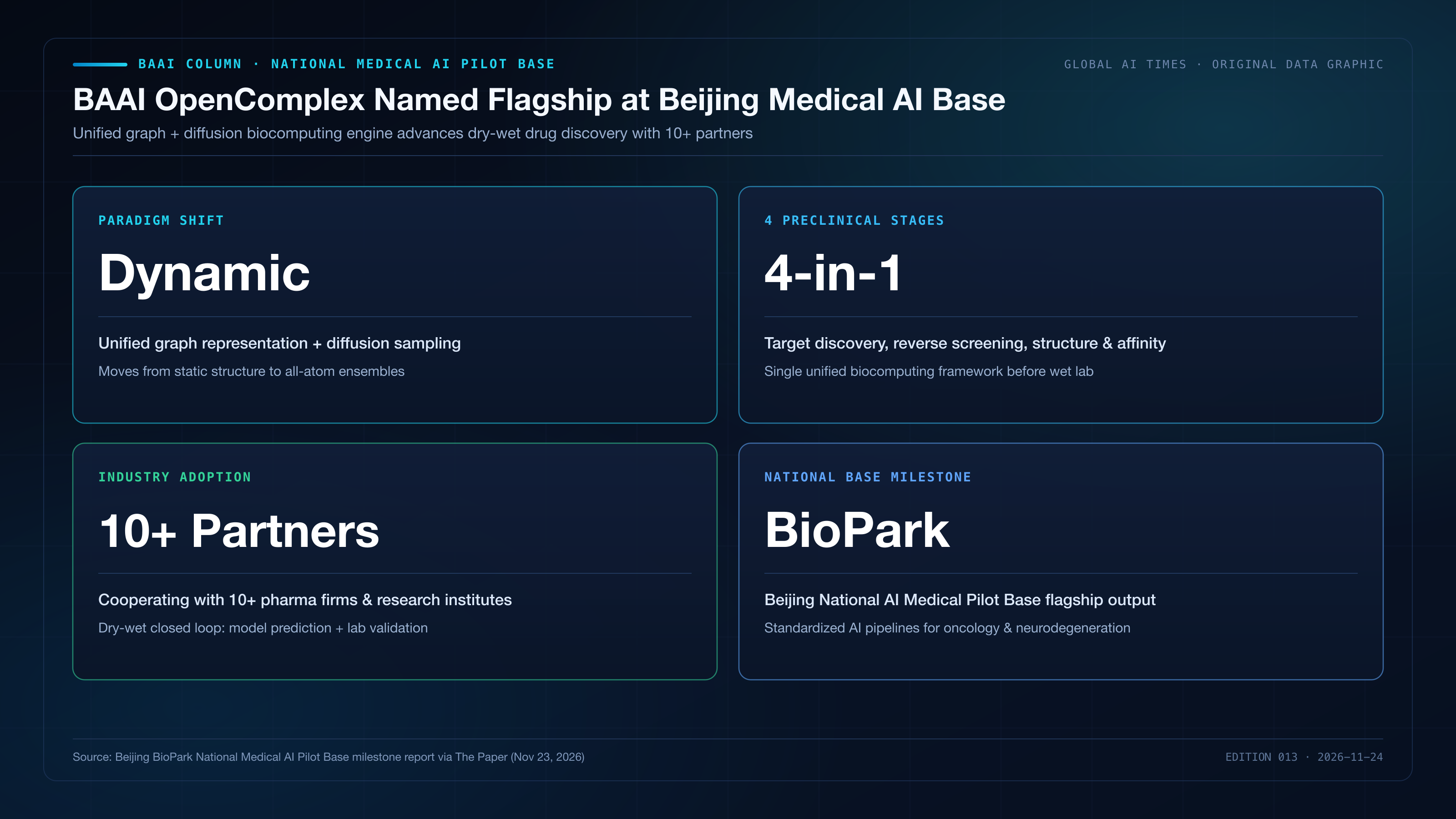
On November 23, an official milestone report released via The Paper's government channel detailed progress at Beijing's National AI Application Pilot Base (Medical) inside BioPark in the Beijing Economic-Technological Development Area—a national platform supporting precision clinical care and biopharmaceutical manufacturing.
In biopharmaceutical manufacturing, the report highlighted OpenComplex—an indigenous biocomputing engine developed by the Beijing Academy of Artificial Intelligence (BAAI)—as a flagship achievement emerging from the pilot base. BAAI representatives noted OpenComplex reduces costly wet-lab trial and error by computationally screening targets, candidate molecules, and binding affinities ahead of laboratory validation.
Technically, the report noted that OpenComplex fuses unified graph representations with diffusion sampling to move beyond static single-structure prediction toward all-atom conformational distributions and thermodynamic ensembles—unifying target discovery, reverse screening, structure prediction, and affinity evaluation in a single preclinical framework.
Through the pilot base's supply-demand matching mechanism, BAAI has established dry-wet closed-loop collaborations ('model prediction + experimental validation') with more than 10 domestic pharmaceutical firms and research institutes, building standardized AI drug-discovery workflows targeting oncology and neurodegenerative diseases.
Sources and accountability
Editorial review completed.