Google DeepMind pairs Gemini 4 agent teams with Lean formal verification to slash quantum circuit costs by up to 290×
On November 23, Google DeepMind published research and open-sourced its GitHub repository formal-quantum-computation, detailing teams of Gemini 4 agents optimizing quantum algorith
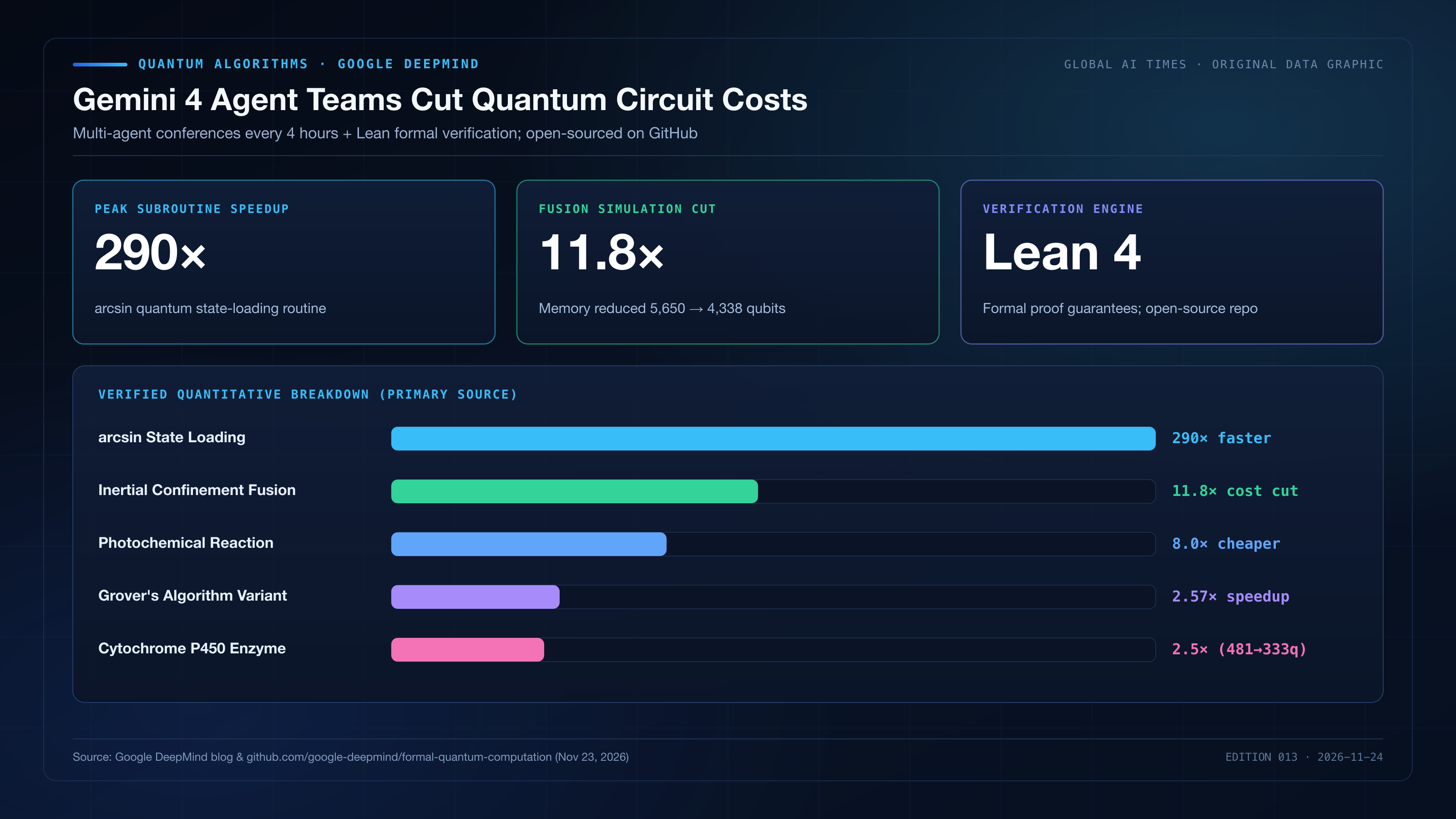
On November 23, Google DeepMind researchers Sergey Shirobokov, Ben Jaderberg, and Ryan Babbush announced results from using collaborating teams of Gemini 4 agents to optimize quantum algorithms alongside Lean formal verification, open-sourcing their Lean library, problem specifications, and verified solutions on GitHub.
Because resource-intensive quantum circuits cannot be brute-force simulated classically or run on today's small quantum processors, mathematical proof is essential. DeepMind assigned separate agent teams to each problem: candidate improvements had to pass Lean formal verification before entering a shared notebook, and teams met every four hours in virtual conferences to debate and refine ideas.
Across scientific simulation benchmarks, agent teams reduced overall computing cost for an inertial confinement fusion calculation by 11.8× while cutting memory from 5,650 to 4,338, made a photochemical reaction simulation 8× cheaper, and achieved a 2.5× improvement for the drug-metabolizing enzyme Cytochrome P450—lowering memory from 481 to 333 qubits by replacing heavy memory lookups.
On core algorithmic primitives, the agents achieved a 2.57× speedup on a specific implementation of Grover's search algorithm and a 290× speedup for the arcsin numerical-loading subroutine. While mathematically verified at the circuit level, practical execution still depends on future fault-tolerant quantum hardware.
Sources and accountability
Editorial review completed.