Zhipu unveils GLM-5.4, its first Loop Transformer flagship looping 28 layers twice in a 750B base for 'broad coding'
On November 23, Zhipu released GLM-5.4, its first flagship model adopting a Loop Transformer architecture by running 28 shared-weight layers of its 750B GLM-5 base for two iteratio
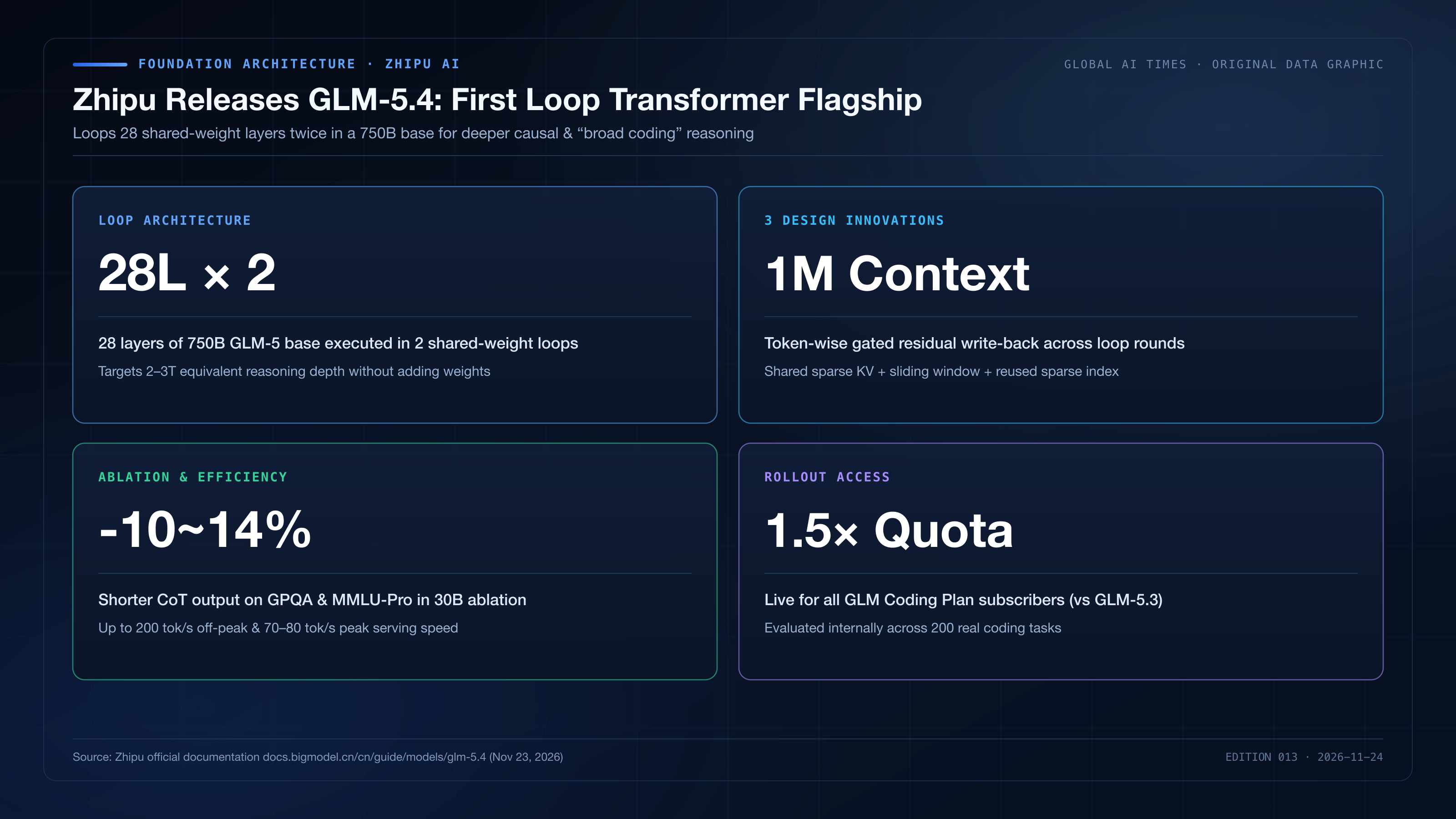
On November 23, Zhipu launched GLM-5.4, its first flagship model built on a Loop Transformer architecture. Rather than pretraining from scratch or expanding parameter count, Zhipu adapted 28 layers of its pretrained 750B GLM-5 base to execute in two shared-weight loops—refining hidden states iteratively to target 2–3T parameter-class reasoning depth.
To make looping viable at 750B scale, Zhipu documented three engineering changes: per-round token-wise residual gating (preventing activation norm blowup while letting round one build global state and round two refine), shared sparse KV caches supplemented by a round-two sliding window to keep 1M-context memory bounded, and direct reuse of round-one sparse attention indices with zero added indexing overhead.
Validating scaling across 1B, 4B, 30B, and 750B bases, Zhipu reported that on an architecture-matched 30B ablation adding roughly 10% training compute, looping yielded the largest gains on math, long-context, and coding while cutting average chain-of-thought output length by 10%–14% on GPQA and MMLU-Pro.
Positioning GLM-5.4 around 'broad coding,' Zhipu highlighted internal evaluations across 200 real coding tasks and cross-domain tool workflows spanning GLSL shaders, FreeCAD, and Blender. GLM-5.4 is open to all GLM Coding Plan users at 1.5× GLM-5.3's weekly quota, with Zhipu reporting speeds up to 200 tokens/s off-peak and 70–80 tokens/s during peak hours.
Sources and accountability
Editorial review completed.