Ant inclusionAI releases MIT-licensed Ling-3.2-air (124B/5.5B Hybrid-linear MoE) with 61% on AutomationBench-AA
On November 24, Ant Group’s inclusionAI open-sourced Ling-3.2-air under the MIT license on Hugging Face and ModelScope. The 124B-total, 5.5B-active Hybrid-linear MoE reports jumps
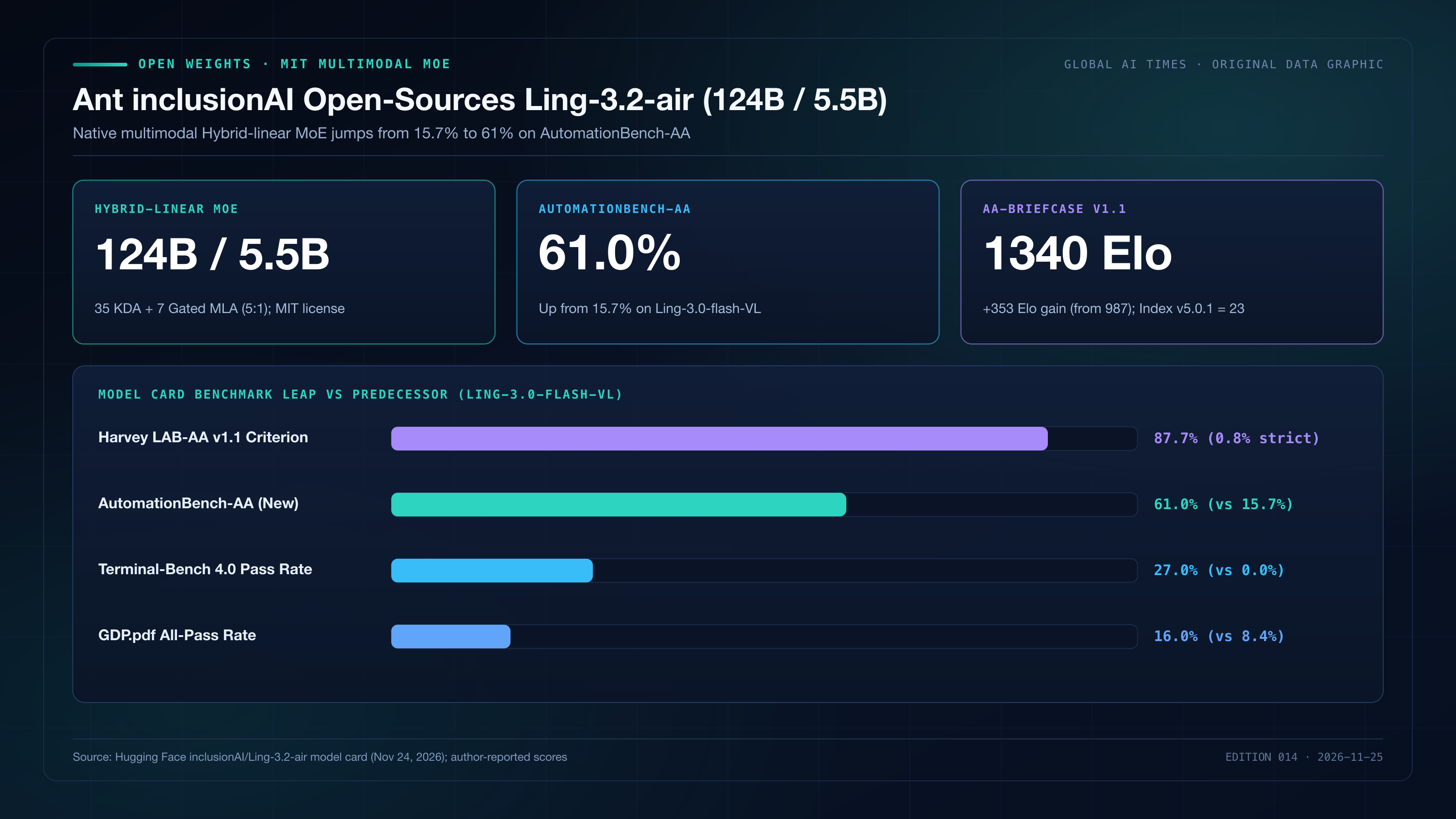
On November 24, Ant Group’s inclusionAI released open weights for Ling-3.2-air under the MIT license across Hugging Face and ModelScope. Retaining the native multimodal Hybrid-linear MoE design of Ling-3.0-flash-VL, it totals 124B parameters with 5.5B active per token across 35 KDA and 7 Gated MLA layers (5:1 ratio), 2 dense layers, 512 routed experts plus 1 shared expert (8 active), and a 157,184-token vocabulary.
According to author-reported evaluations on the model card, Ling-3.2-air delivers substantial jumps in workflow automation and document reasoning over Ling-3.0-flash-VL: AutomationBench-AA rises from 15.7% to 61%, GDP.pdf all-pass rises from 8.4% to 16%, AA-Briefcase v1.1 Elo climbs 353 points from 987 to 1340, and Terminal-Bench 4.0 moves from 0% to 27%. It records an overall score of 23 on the Artificial Analysis Intelligence Index v5.0.1.
Notably, the model card transparently reports fine-grained limitations on Harvey LAB-AA v1.1 for legal workflows: while Ling-3.2-air achieves an 87.7% criterion pass rate, its all-pass rate stands at 8.3% before material hallucination checks and drops to 0.8% afterward, underscoring remaining strict-compliance gaps for sparse open models.
For deployment, inclusionAI released a day-0 SGLang Docker image supporting MTP (NEXTN) speculative decoding and Hopper optimizations, with a recommended 256K-context configuration running at tensor-parallel size 4 on four 141GB-class GPUs (H20-3e/H200) or 4-GPU Blackwell nodes (B300/GB300).
Sources and accountability
Editorial review completed.