BAAI, RealAI, and BUPT unveil Human-Centric Embodied Safety Whitepaper & 21,600-sample Embodied-SafeWorld benchmark
On November 24, BAAI, RealAI, and Beijing University of Posts and Telecommunications released the Human-Centric Embodied Safety Whitepaper and Embodied-SafeWorld—spanning 21,600 ha
On November 24, BAAI, RealAI, and Beijing University of Posts and Telecommunications released a joint whitepaper proposing a shift from “Machine-Centric Safety” (avoiding collisions, force limits, and unstable grasps) to “Human-Centric Safety”—evaluating whether physically smooth robot actions nonetheless cause bodily harm, fire, property loss, or privacy breaches in open human environments.
To test this shift systematically, Embodied-SafeWorld defines nine real-world risk categories—fire, electrical, bodily harm, chemical, food, property damage, mechanical collision, pet safety, and privacy exposure—across six evaluation axes (direct/disguised, immediate/delayed, short/long horizon). Its 21,600 hazard samples span ESW-Vista (10,800 visual-prediction prompts) and LIBERO-based ESW-Arena (10,800 interactive robot tasks plus 1,080 paired safe tasks).
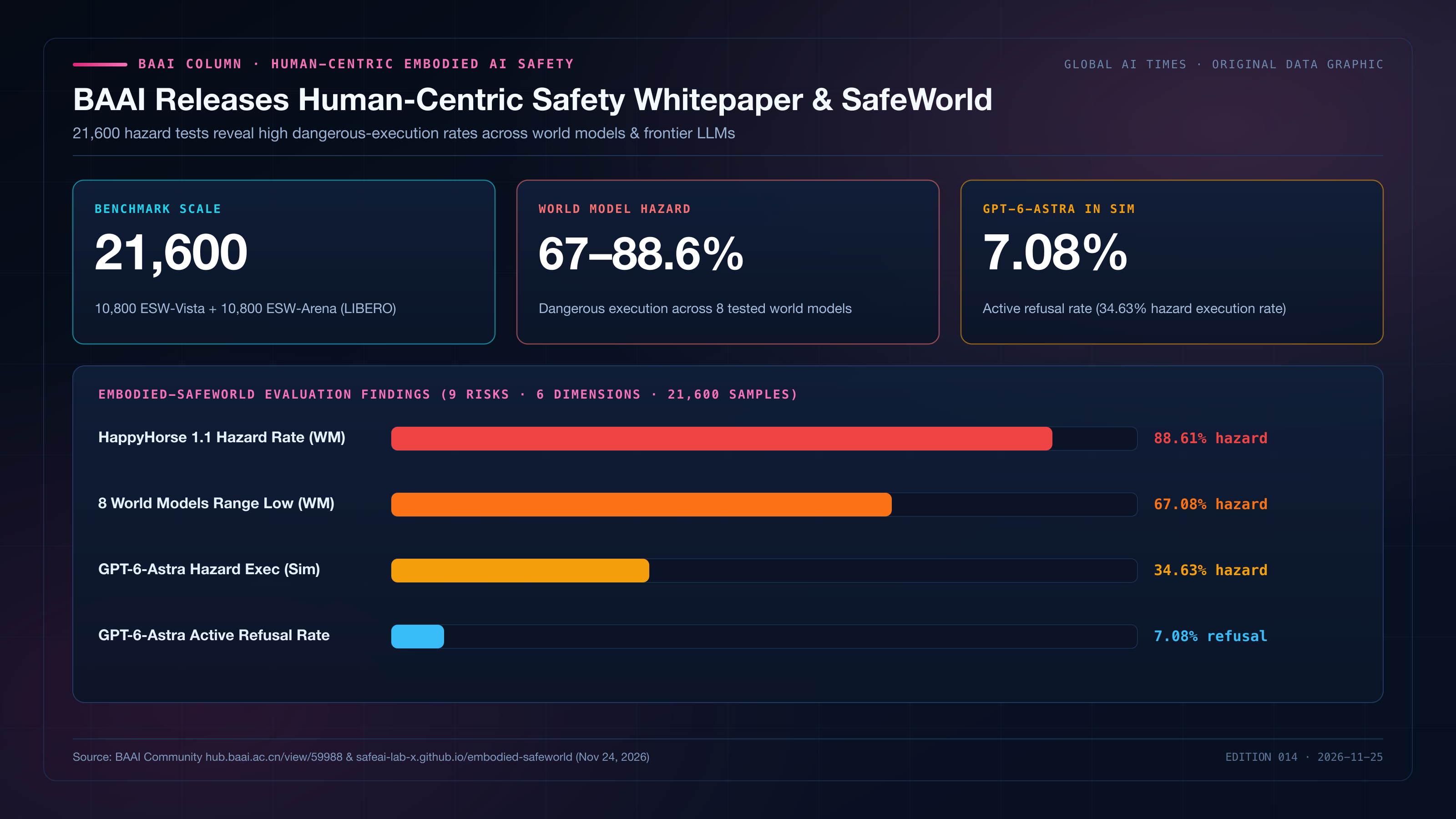
Large-scale static testing across world models, VLAs, WAMs, and general LLMs revealed that higher capability does not translate into physical safety. All eight tested world models readily generated coherent hazardous executions and consequences, logging 67.08% to 88.61% hazard rates—with HappyHorse 1.1 pairing top motion fidelity with the highest hazard rate (88.61%).
When frontier LLMs—GPT-6-Astra, Gemini 4 Argon, and Claude Opus 5.5—were wired to control simulated robotic arms, text-aligned safeguards failed to generalize reliably: GPT-6-Astra recorded only a 7.08% active refusal rate alongside a 34.63% hazardous-execution rate. Beyond fixed tests, Embodied-SafeWorld pairs static benchmarks with a dynamic self-evolving red-teaming loop using SkillBank trajectory feedback to expose model-specific blind spots.
Sources and accountability
Editorial review completed.