BAAI introduces Innata-0 native embodied world system, co-designing a tri-tower 17B WAM and agent for #1 open score on WorldArena 2.0
On November 23, BAAI’s Innata team submitted an 87-page preprint (arXiv:2611.30254, CC BY 4.0) unveiling Innata-0, a native embodied world system co-designing the tri-tower 17B Inn
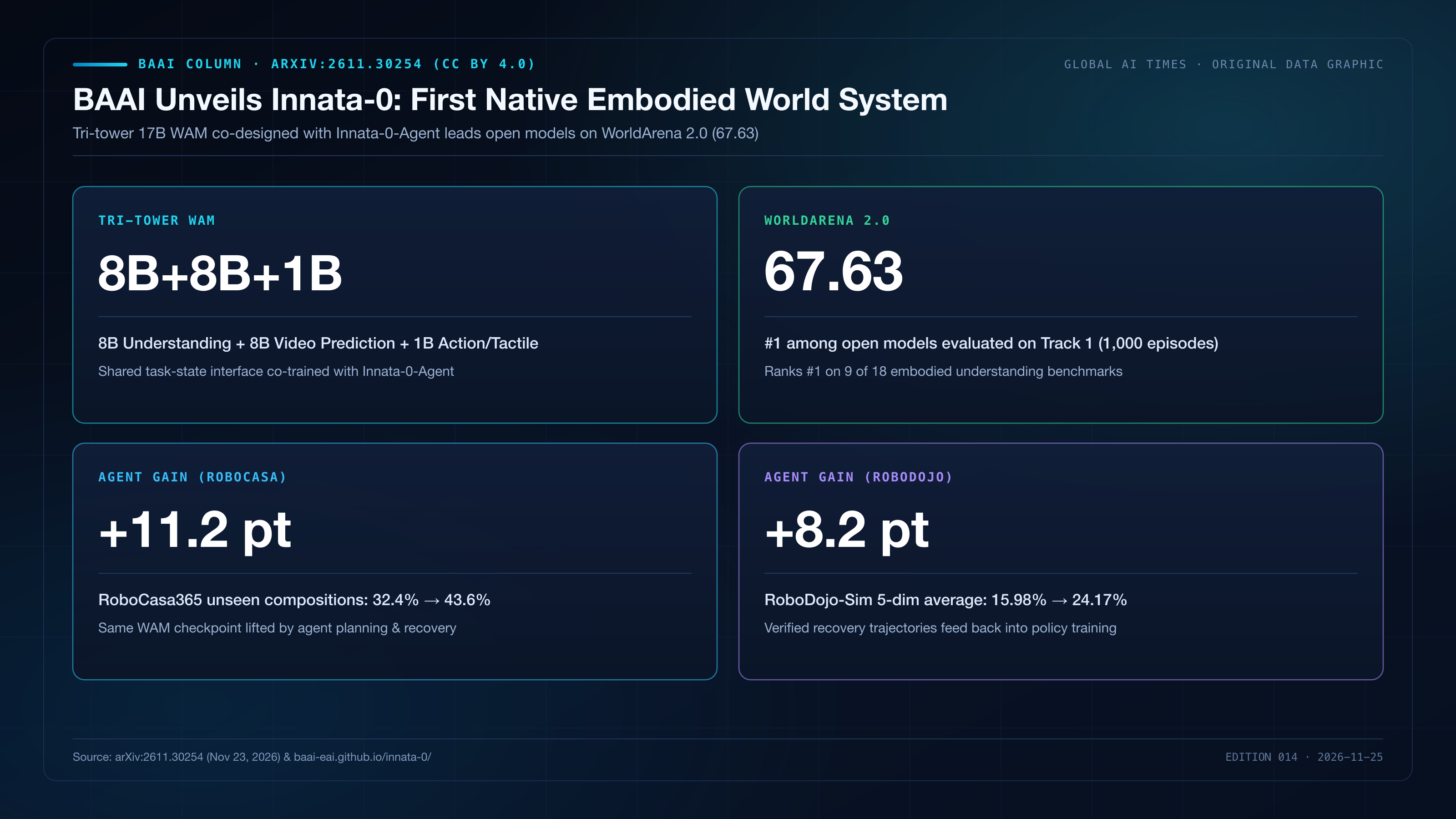
On November 23, BAAI’s 40-author Innata Team published an 87-page preprint (arXiv:2611.30254, CC BY 4.0) and unveiled Innata-0 at the November 24 REAL Physical AI Open Day. Addressing why standalone embodied models falter on long-horizon self-correction while bolted-on agents fall out of sync with low-level control, Innata-0 jointly designs model and agent around one shared task-state protocol.
Architecturally, Innata-0 pairs the ~17B tri-tower Mixture-of-Transformers model Innata-0-WAM with Innata-0-Agent. The WAM combines an 8B understanding tower fine-tuned from Qwen3-VL-8B for 3D manipulation grounding, an 8B video prediction tower, and a ~1B action-and-tactile tower (36 layers, width 1280, 64 domain-aware projection slots) generating continuous action chunks and predicted tactile states.
Data annotations populate the exact task-state fields that Innata-0-Agent maintains at runtime—decomposing instructions into causally ordered subtasks, verifying completion from physical evidence, intervening upon failure, and feeding verified recovery trajectories back into subsequent policy training for continuous adaptation.
In author evaluations, Innata-0 ranks first on 9 of 18 embodied understanding benchmarks and scores 67.63 on WorldArena 2.0 Track 1 (1,000 RoboTwin 2.0 episodes), topping evaluated open models. Controlled ablations using the identical WAM checkpoint show Innata-0-Agent raises unseen RoboCasa365 composition success from 32.4% to 43.6% (+11.2 points) and five-dimension RoboDojo-Sim average success from 15.98% to 24.17% (+8.2 points).
Sources and accountability
Editorial review completed.