BAAI launches 158-indicator REAL Physical AI evaluation suite and four inaugural leaderboards at Beijing Open Day
As reported from Beijing by Zhidx on November 24, BAAI unveiled the REAL Physical AI evaluation framework—spanning 5 domains, 14 dimensions, 55 capabilities, and 158 indicators—alo
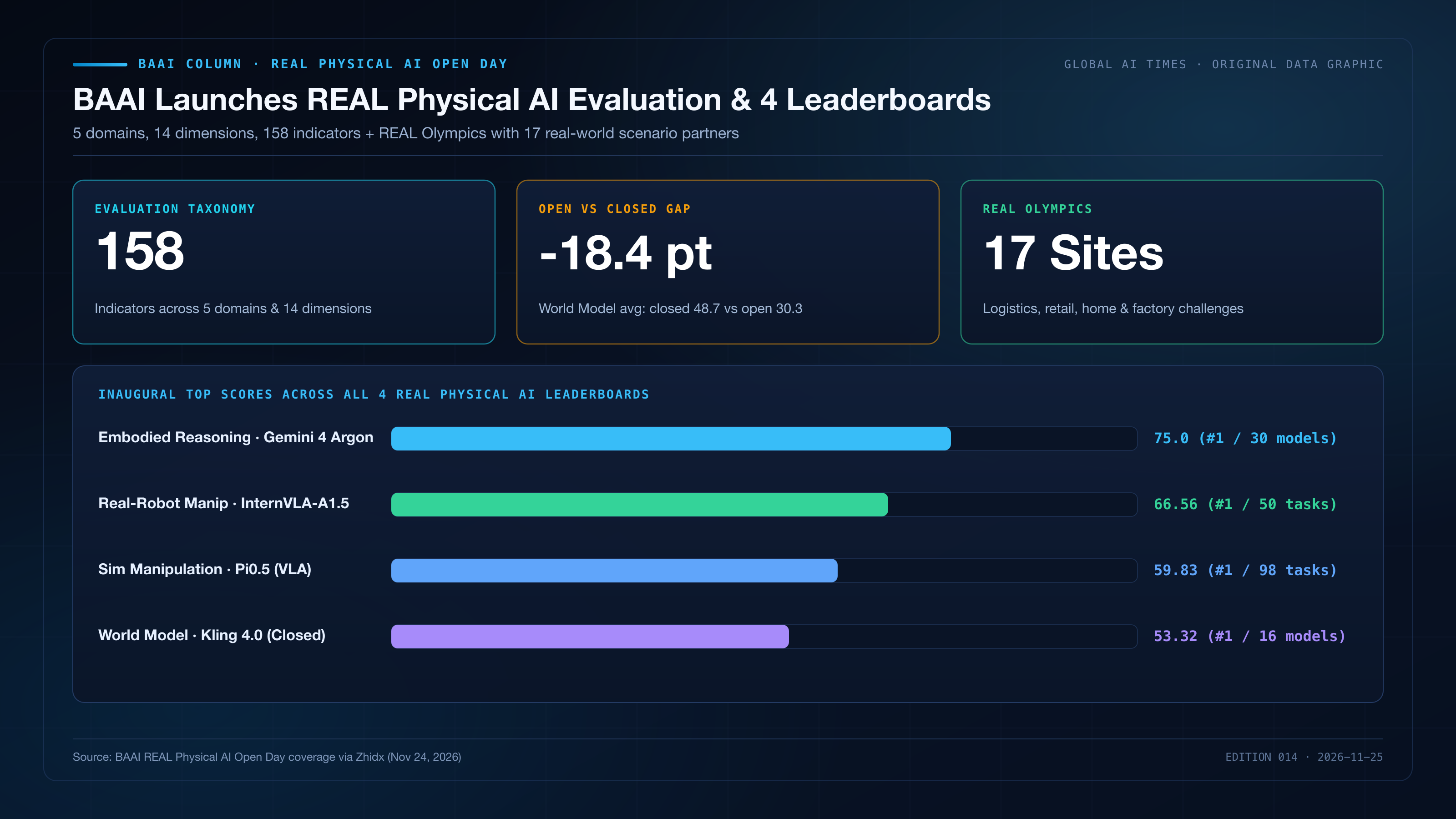
According to November 24 coverage by Zhidx’s Robotics Frontier from BAAI’s REAL Physical AI Open Day in Beijing, BAAI and industry partners introduced the REAL Physical AI evaluation framework. Spanning 5 capability domains, 14 dimensions, 55 capabilities, and 158 indicators across model, robot-system, and application tiers, the suite bridges digital, simulated, cloned, and real-world environments.
BAAI unveiled four inaugural leaderboards from the framework. On the World Model board (16 video world models, 1,113 questions), closed model Kling 4.0 led with 53.32 while MiniMax H3 topped open models at #8—exposing an 18.4-point gap between closed (48.7 avg) and open (30.3 avg) models. On Embodied Reasoning (30 models, 13,262 questions), Gemini 4 Argon led at 75.0, Kimi K3.1 Pro was the top open model at #5 (65.8), and RynnBrain1.1-122B-A10B placed #18 (49.5), with scores strong on science understanding (83.8 avg) yet weak on short-term memory (37.8).
Across robotic manipulation, the Simulation board evaluated 10 models across 98 tasks and 42,000 validation rollouts, where VLA model Pi0.5 ranked first at 59.83; the Real-Robot board tested 10 models across 50 tasks and 5,000 rollouts, topped by InternVLA-A1.5 at 66.56. BAAI also launched REAL Olympics with 17 real-world scenario partners covering logistics, auto retail, home services, and manufacturing.
BAAI also announced HumanCOIN, an open-source 12,500-hour egocentric “observation–intention–action” dataset across 38 scenes and 635 objects incorporating EMG, EEG, and motion-capture signals (samples open now; full release planned before Chinese New Year 2027). Speaking after the event, BAAI President Wang Zhongyuan described VLAs as task-specific “cerebellums” while world models target broader reasoning and generalization, stressing that reliable, low-cost real-world deployment—not taxonomy labels—matters most.
Sources and accountability
Editorial review completed.