OpenAI reports GPT-6 models design novel protein binders via reasoning and code, with 35 of 322 wet-lab hits
On November 24, OpenAI published research demonstrating that its general-purpose GPT-6 family can design novel protein structures and amino-acid sequences using reasoning and codin
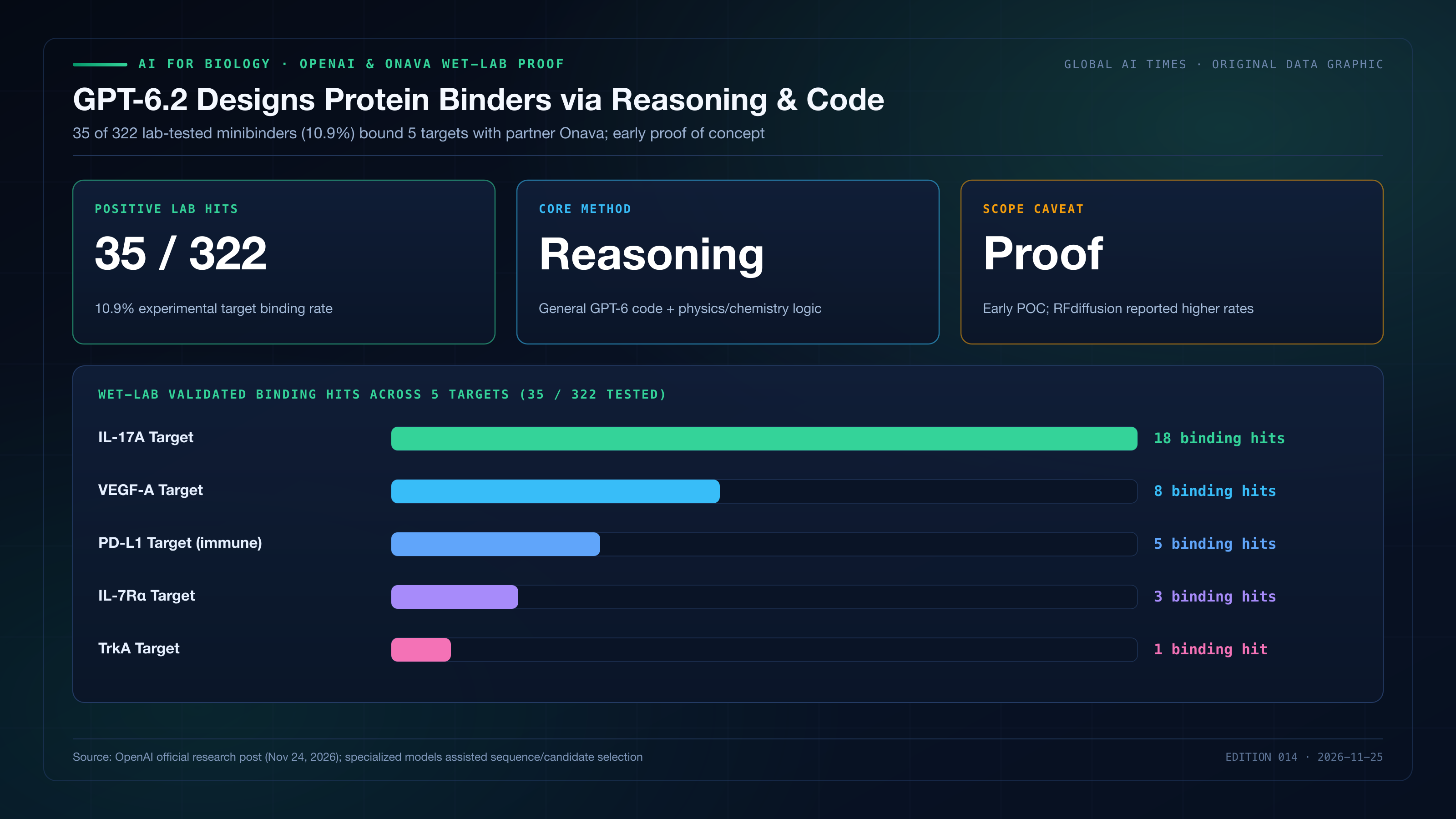
On November 24, OpenAI published a research report detailing how its general-purpose GPT-6 model family exhibits intrinsic protein-design capabilities—generating novel three-dimensional protein structures and amino-acid sequences using reasoning and general coding tools rather than calling specialized biology generators.
In laboratory experiments conducted with research partner Onava, OpenAI tested 322 minibinders based on GPT-6.2 designs against five targets. Thirty-five candidates (10.9%) tested positive for target binding: 18 against IL-17A, 8 against VEGF-A, 5 against PD-L1, 3 against IL-7Rα, and 1 against TrkA. Redesigned antibody binding regions also retained binding in testing.
OpenAI explicitly noted methodological boundaries: specialized biology models assisted in supplying sequences and selecting candidates sent for lab testing. On computational quality metrics, GPT-6.2’s 3D structures scored slightly below RFdiffusion, whereas OpenAI’s latest internal research model matched or outperformed specialized baselines. OpenAI also acknowledged that the original RFdiffusion study reported higher wet-lab hit rates, which depend heavily on filtering strictness.
According to OpenAI, the broader significance lies in pairing natural-language steering with physics, chemistry, and biology reasoning—letting scientists specify constraints from a single atomic bond to overall protein shape without rebuilding specialized toolchains for each task, while emphasizing that the work remains an early proof of concept.
Sources and accountability
Editorial review completed.